
Introduction
The Portable power board raised, will allow us along with our gadgets to measure current, be one step closer in the goal of having tools that we will be using in the next projects.
IThese devices can be seen in our last publication, giving in the previous links.
The purpose of the project is to have a heavy equipment that allows us to connect several elements in electrical outlets protected by tacos or breakers. The design is designed in such a way that we can transport it easily.
TWe will use the power board to perform exterior or interior work where we require several connection points and are properly protected. We can connect it to an electrical extension for external use duly protected by expanding the coverage or radius of action of our project.
IThis is the case of assemblies, maintenance in industrial plants or home projects that require an electrical outlet far from a connection point.
In lab work and tests will allow us to isolate ourselves from the main circuit of the place where we are. This way we will be able to carry out the projects that require multiple electrical points insured by their taco in a safe way.
It is recommended that the electrical installation have a ground pole where we connect the board directly or through an extension. All elements must have a ground connection to ensure the safety of people and equipment or tools that connect to the board.
List of Materials
Box of at least 2 breakers
1 taco or breaker of 20 amps
Heavy duty 6-way power strip
2 pipe plugs for ½ "water
6 conduit curves of ½ "
2 segments with neck (union) of 13 cm (5 1/8") long conduit pipe of ½ "
1 segment of 15.5 cm (5 7/8") long ½ "conduit pipe
2 straight segments of 8 cm (3 1/8") long ½ "conduit pipe
1 union of ½ "water pipe
2 pipe elbows for ½ "water
5 simple clamps for ½ "pipe
2 double wing clamps for ½ "pipe
1 Wooden board of 35cm x 28cm x 1.8cm (13 3/4" x 11" x 3/4")
3 meters (10 ft) of heavy duty outdoor cable 3 x 12 Awg (preferably)
3 meters (10 ft) 12 awg wire
10 cm (4") plastic ½ "shell
2 half-inch ( ½”) conduit connectors
1 plug or connector with ground pole
1 wire rope press
Wood screws
Process of Armed
AWe connect the cable to the plug, the other end of the cable is connected to the respective terminals of the plug box. The phase is connected to the breaker (s) that we want to place in our power board.
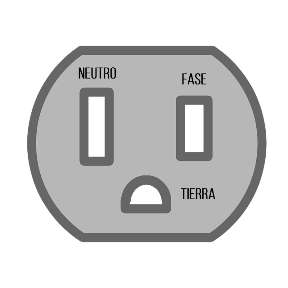
We will respect the polarity of connection for the respective plugs, I recommend that you normalize your connections according to the graph provided where the polarity of each terminal is shown according to the standard.
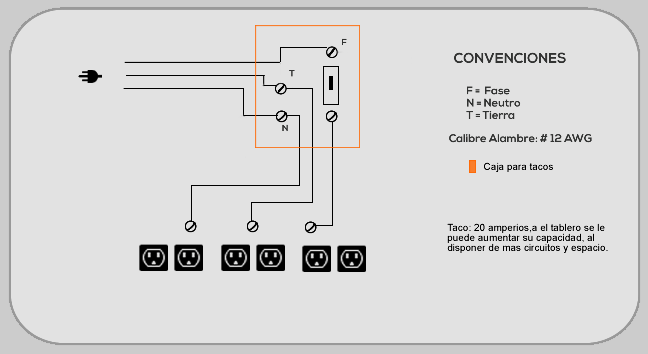
YFor load handling purposes according to wiring gauge, I recommend looking at the supplied Caliber vs Current table. You can see expanded information in the article Alternating Current Measuring Devices, to choose the plug for the circuit. For this case we will use a 20 amp plug.
DFrom the box of breakers, we feed the current sockets with their respective breaker taking care of the polarity according to the norm, see the graph. Remember that you can install more circuits depending on the capacity of your breaker box.
IThe conduit structure is assembled, as shown in the video. In the unions of the tubes it is recommended to use glue for pipes or any other type that you find available to give more resistance to the structure. Finally, we proceed to fix the structure of tubes to the wooden board by means of clamps and screws.
II suggest as an extension of the power board an electrical extension with ground pole cable 3 x 12 awg. These types of extensions are expensive or difficult to find in the market. I assemble a 27 meter one, buy the meters of 3-wire # 12 wire cable, the plug and socket. In this way I made a great saving.
Next Project
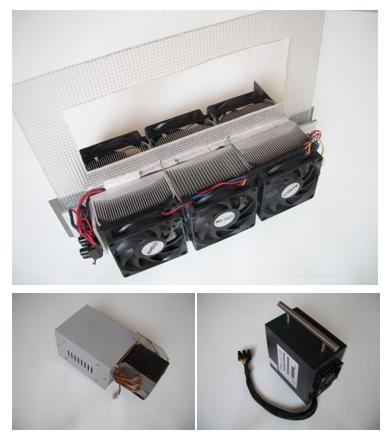
BWell in this way we have finished this project that we will use together with the current meters in our next invention, where we will raise the level. We will make a Power Source with high load capacity or current. Able to feed 3D printers, peltier cells or other project that requires a supply of 3, 5 or 12 volts and a load of 20 real amps.
OSee you in the next montage.
 English
  Español
Leave a Reply